


Mapping the flow of music publishing
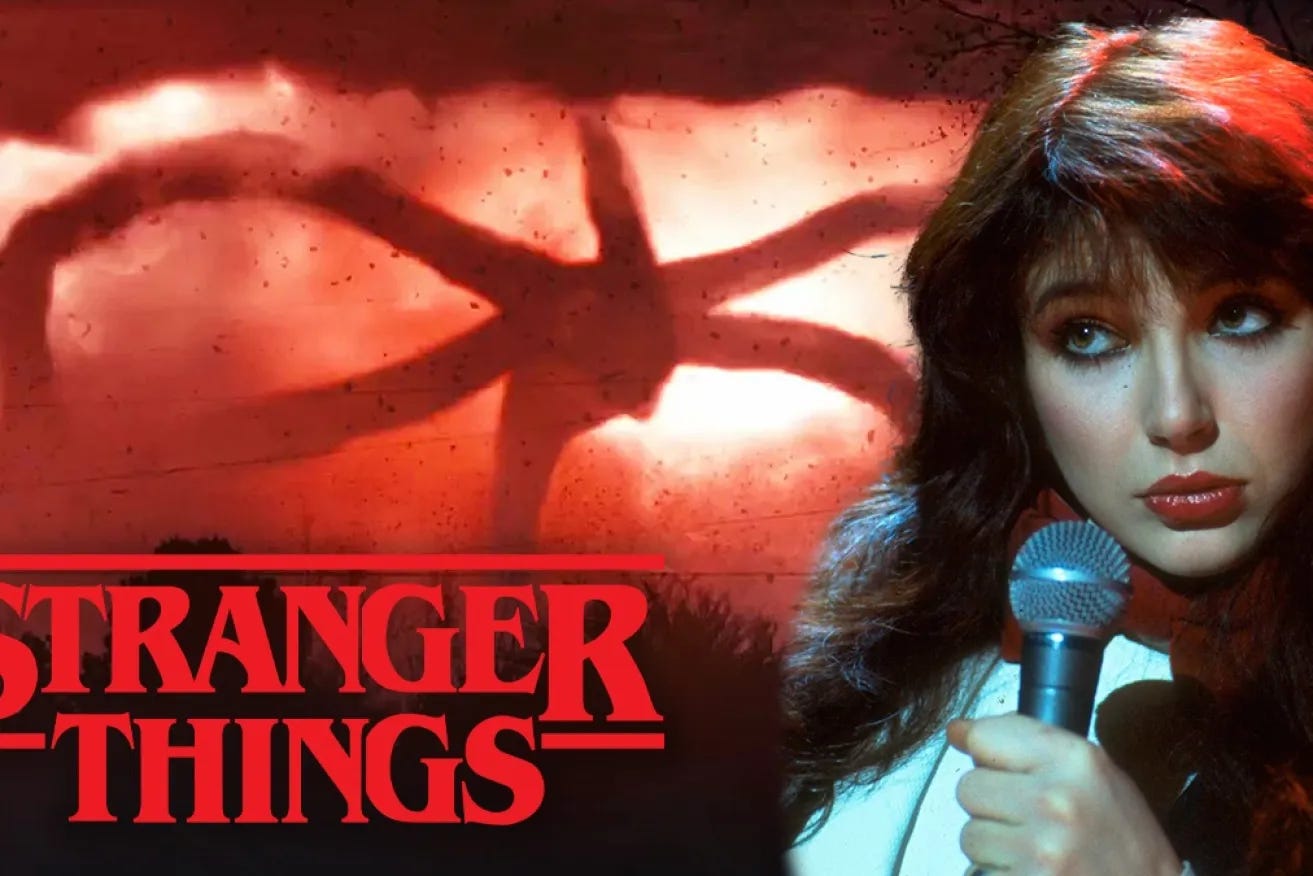
In 2022, Kate Bush’s song Running Up That Hill was famously featured on Stranger Things.
Kate Bush rarely licenses her music to film or TV, so the music supervisor wrote a long, personal essay asking for clearance, and explaining why the track was so important to the storyline and character throughout season four.
It worked and Kate Bush agreed. The placement ended up generating an estimated $3.5 million in fees and downstream royalties for Bush.
This TV placement is the perfect example to explain how music publishing works (the most confusing, and fastest-growing, half of the music industry!) Just look at how many unique publishing payments it triggered:
Running Up That Hill - Counting the music publishing payments
Kate Bush agrees an upfront fee for use of her track [publishing sync fee].
She now earns a [performance royalty] every time the episode is viewed.
The resurgence in popularity is so strong that Running Up That Hill gets a 9,000% streaming bump and hits a billion plays on Spotify [mechanical royalty].
The song is play-listed across radio stations all over the world and played in bars and cafes everywhere [performance royalty]. It re-enters the Top Ten in more than 20 countries.
Fans on social media use the song in their Instagram Reels and make UGC covers and edits on TikTok [blanket license and performance royalty].
More than 100 covers and remixes are released by other artists. All driving [mechanical royalties] and [performance royalties] back to the original songwriter, Kate Bush.
Coldplay plays a cover version live at Wembley and Halsey plays it at festivals that summer [performance royalty].
From one TV placement, it triggered millions in downstream publishing royalties, in dozens of different ways.
The power of music publishing
This example shows how powerful and wide-reaching music publishing can be. It touches every aspect of where music is played.
And it’s growing fast.
The growth in music publishing now outpaces recorded music. So now, more than ever, it’s important to understand the ecosystem, how it works, and where the opportunities are.
This week’s map aims to capture how money flows in the music publishing world.
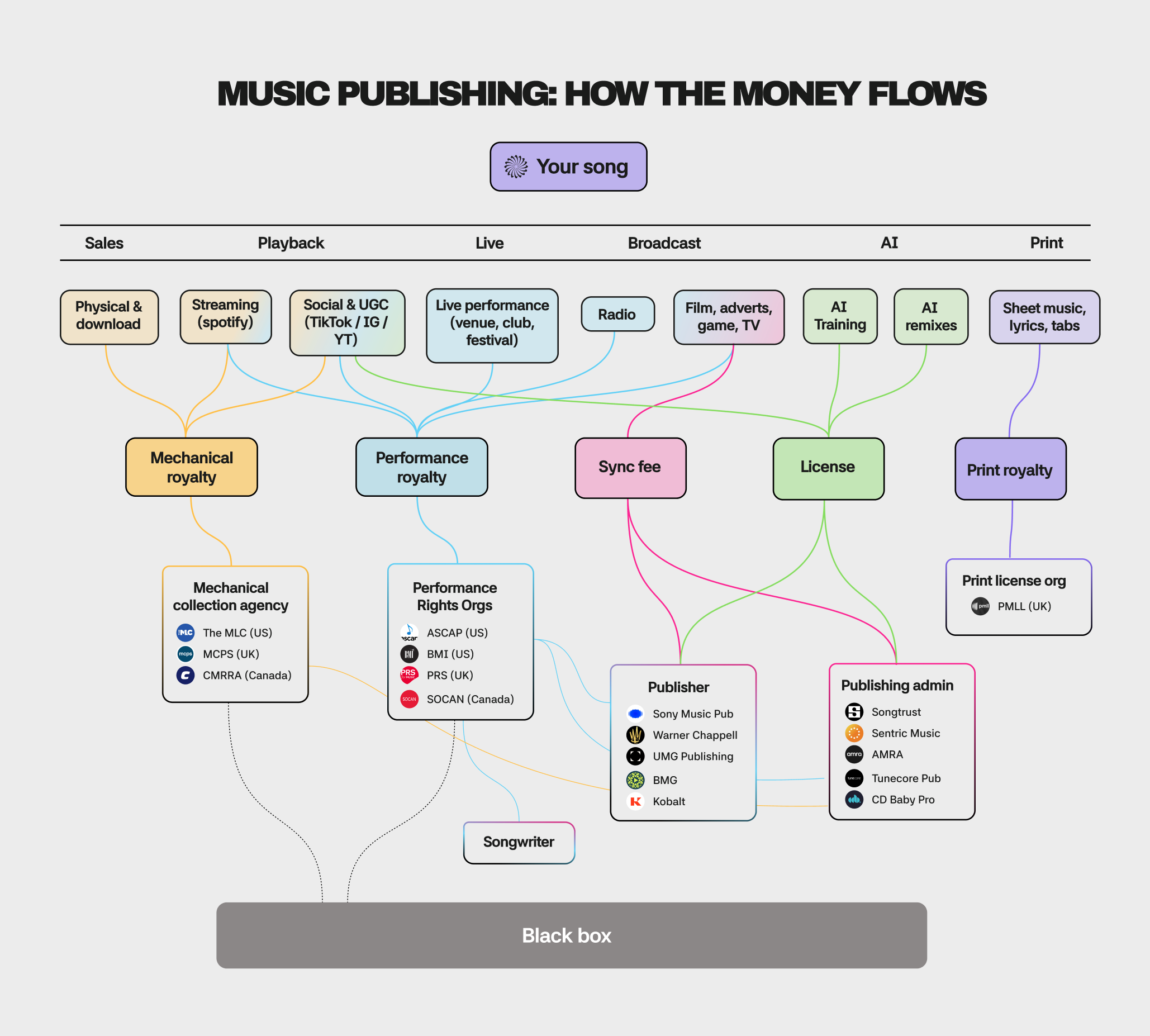
This part 1 covers the basics of how music publishing works. Next week, we’ll go deeper and highlight the companies, tools and opportunities across the publishing stack.
But first, why does this matter now?
Publishing growth overtakes Recorded music
In 2022, music publishing growth overtook recorded music growth in the US for the first time. (Coincidentally the same year that Kate Bush licensed Running Up That Hill to Netflix!)
Publishing has continued to outpace recorded music every year since (in the US).
It doesn’t get talked about much. But it’s clear that music publishing is becoming a much more important part of the music business. And if we’re heading to a future of infinitely remixable AI music products … then songwriting and publishing might be the heart of all value-capture in music.
Contents
What is music publishing?
What triggers a music publishing payment?
Five ways music publishing earns money (mechanical, performance, sync fee, licenses, print royalty)
Who collects music publishing payments?
Why is music publishing growing fast?
Untapped publishing opportunities
Is AI good or bad for music publishing?
1. What is music publishing?
Every song has two types of rights:
Recorded rights (“master”) - The actual recording of the song. The version you export from your DAW and upload to Spotify.
Publishing rights - The composition of the song. The lyrics, the notes, the essence of the song in whatever format.
A simple way to think about it? Imagine you record a cover version of “Running Up That Hill” in your bedroom. You own the recording rights or “master” for the song (because you recorded a new version of the song). But Kate Bush will always earn the publishing rights (because she wrote the notes and lyrics).
The purest way I think of it is: publishing is songwriting. It drives value back to the original creator of a song, in whatever format possible.
2. What triggers a music publishing payment?
Almost everything!
Any time you hear music, it triggers a publishing payment somewhere:

On a video game
On the radio
In a shop or restaurant
On a film or TV show
Advert
At a live show
On Spotify or YouTube.
On any new music tech platform.
At the theatre
Scrolling TikTok
Simply put … if you hear music anywhere in the world, in any format, there’s a publishing royalty associated with it.
And so begins an extremely complicated web of tracking and paying the correct artists and organisations.
3. The five ways music publishing earns revenue
Publishing is much more difficult to track and collect than recorded music because it’s triggered from so many different places.
There are basically five ways to earn on the publishing side:

a. Performance royalties
Performance royalties are triggered every time your song is played or broadcast in public. This could be a live show, in a store, on the radio, on the TV, at a bar or restaurant, etc. This is the largest pool of publishing money (about 52%).
b. Mechanical royalty
A mechanical royalty is triggered when your song is streamed, downloaded or reproduced on physical forms (CD or vinyl). This accounts for ~19% of publishing revenue.
c. Music sync license
In addition to these two royalty streams, you can also earn a large upfront publishing fee if your music is used in an advert, TV show, movie or video game.
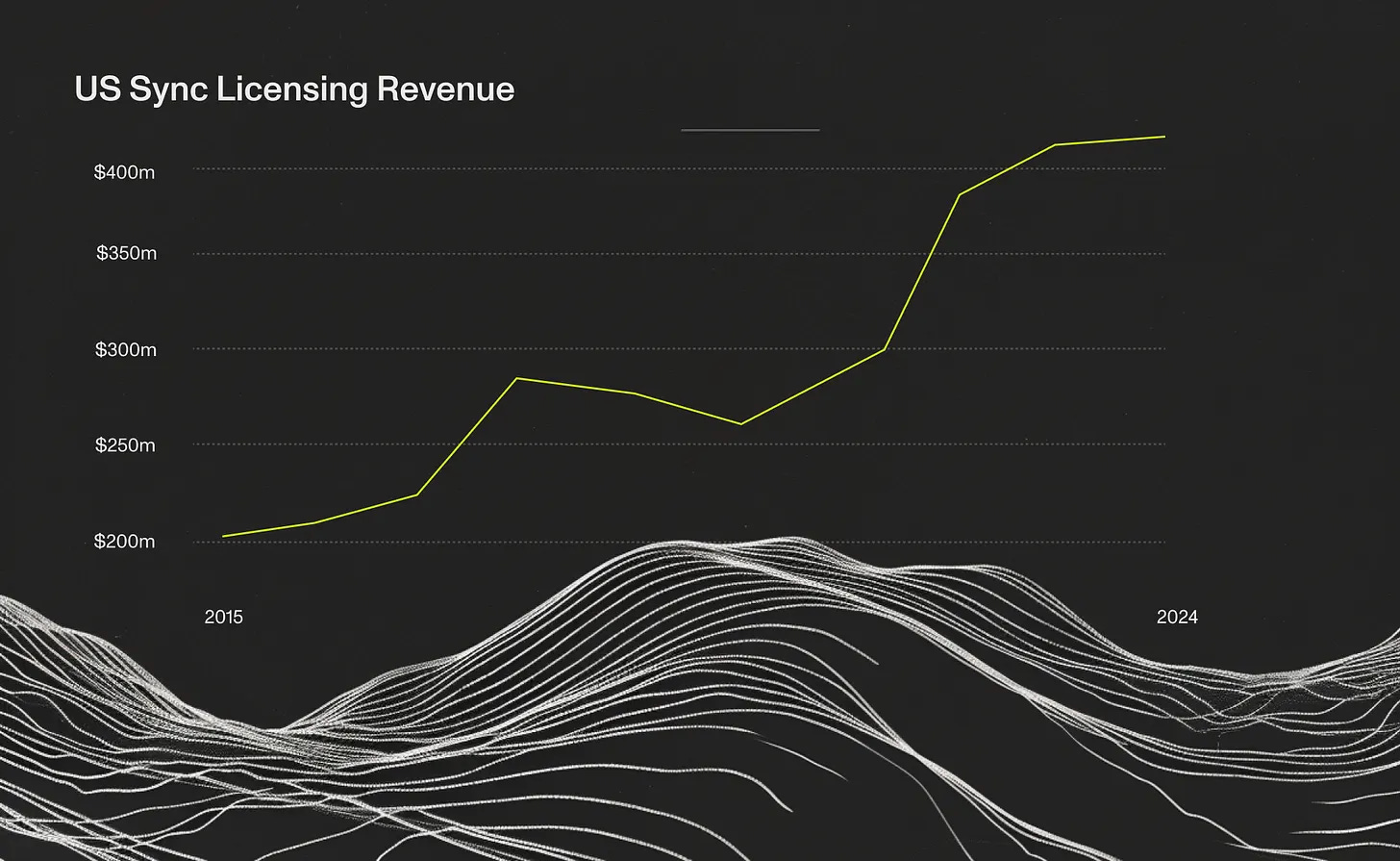
This corner of the music industry has seen rapid growth in the last ten years, and now accounts for ~24% of publishing revenue.
d. Blanket licenses
Blanket licenses are used to capture mass music use where it’s difficult or impossible to capture a single song use. Typically we see these for social media / UGC and some early new AI licenses.
Social media / UGC - TikTok, YouTube and Instagram have a “blanket license” with publishers to cover a huge catalog of music.
AI licenses - Publishers are beginning to negotiate licensing deals with AI companies to cover both AI training and AI remix outputs. For example, Kobalt has cut publishing deals with ElevenLabs and Udio.
This category is currently estimated less than 5% of publishing revenue, but it has room for growth. The deals here are patchy and fragmented which means the true value probably isn’t being captured yet.
e. Physical or print royalties
This is triggered if your sheet music is published and sold anywhere. Same goes for your lyrics or guitar tab notation.
It’s a small part of the publishing royalties stack, but it’s still useful for many artists.
4. Who collects music publishing payments?
So … we know the surface area for earning publishing royalties is huge.
But actually collecting it? Not easy.
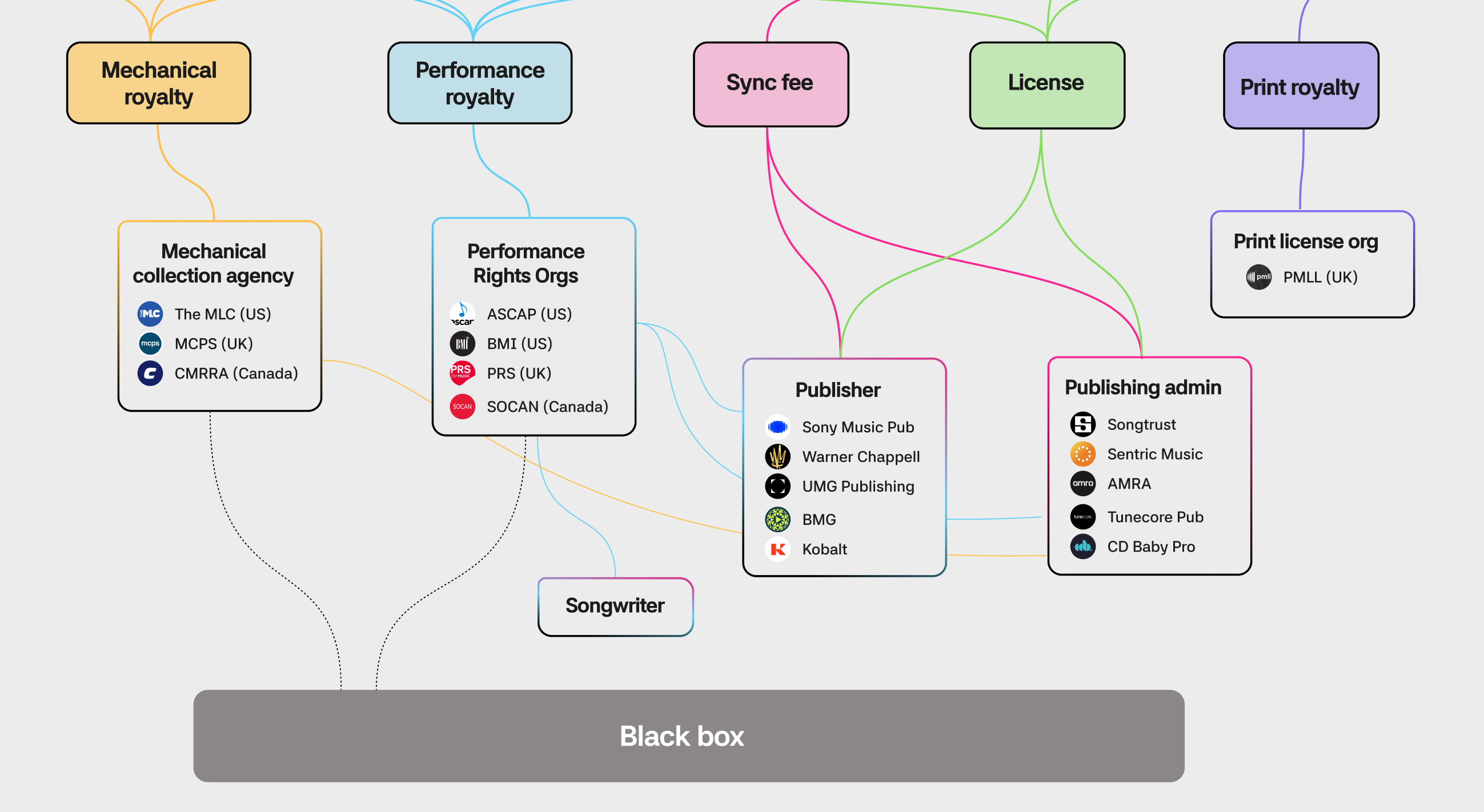
Those performance royalties and mechanical royalties? They are not automatically sent to artists. They’re collected by a web of different agencies in every part of the world … and you must actively join those agencies and register all of your music.
Here’s a quick glance at the collection agencies based on region:
Performance royalties: ASCAP or BMI (USA), PRS (UK), SOCAN (Canada), GEMA (Germany), SACM (Mexico)
Mechanical royalties: The MLC (USA), MCPS (UK), CMRRA (Canada), GEMA (Germany).
You must be a member of these organisations and register all of your work (correctly, with no errors) to receive any publishing royalties.
Further reading: I recommend reading Joel Gouveia’s article: “How to collect every dollar your song earns” if you’re an artist and want to make sure you’re fully registered for all publishing royalties.
… And if you don’t collect it … it goes in the black box
Your publishing revenue can unfortunately get completely lost in this complicated web, and end up in the infamous “black box.”
The black box essentially means that a collection agency has tracked your song, but can’t match it to the right artist. Instead, your money goes into the “black box” for a holding period of 2-3 years. And if it remains unclaimed it will get distributed to all rightsholders based on marketshare (largely the major publishers).
What could cause this to happen?
If your music is not registered with a collection agency.
Metadata problem: typos in your name, incorrect song titles, missing ISRC codes.
Inconsistent splits: you register a song as 50-50% split but your collaborator registers it as 60-40%.
Geographical plays: your song gets played in a country that can’t easily match it with your territory.
Approximately $2.5 billion of royalties accumulates in the black box every year, and some estimates say it could grow to an $8 billion annual problem.
Publishers vs publishing admin?
If you’re an artist reading this, you have a few options to ensure you’re capturing all these royalties:
DIY - you can join all the collection agencies, register your works, and handle all sync license requests yourself.
Publisher - you can sign to a publisher who will handle all of this for. They’ll actively go out to secure syncs and grow your publishing revenue. However, they will own your publishing rights in exchange.
Publishing admin - A publishing admin company doesn’t own your rights. Instead, they’ll register your works, collect and organise your royalties for a percentage share of revenue. The main difference is that publishing admin companies are not typically “active” in sourcing syncs or increasing revenue for you. But they will “passively” collect everything that you’re owed, which can be a great starting point for newer artists.
5. Why is music publishing growing faster?
A couple of simple reasons: Publishing income is more diverse and distributed than recorded music, so there’s a growing surface area to capture revenue outside of pure streaming (social, syncs, gaming, AI, etc). And the technology to capture revenue from all the different playback sources is getting better.
Unlocking unpaid royalties - The music industry is aggressively chasing down anyone playing or exploiting music without license and forcing them to pay. The technology to track performance royalties when music is played in public is improving. More than $2.5bn of 2024’s revenues (about 27%) came from these actions.
Better rates on publishing royalties - Several court orders have raised the publishing rates on streaming from 10.5% in 2018 to 15.1% today.
New avenues for publishing revenue - Gaming, fitness apps, user-generated content and social apps often pay higher publishing rates than the music streaming services. And the number of digital experiences with music licensing is growing. Mobile games are expected to 4x their spend on music by 2030.
Boost in sync-licensing - Sync licensing revenue has doubled in the last decade (from $200 million in 2015 -> $400 million in 2024). Licensing across content-platforms like Netflix and video games are providing fresh paths for growth.
Generally speaking, publishing can piggy-back on growth across every part of the industry. If streaming grows, publishing captures revenue via mechanical royalties. If live music grows, publishing captures performance royalties. If new digital products open up, publishing captures new licensing opportunities.
6. The untapped publishing opportunities
There are two ways I think about opportunities in the publishing space:
Plug holes in the existing system - as you can see in our map, billions of dollars ends up in the publishing “black box” because it isn’t correctly attributed. Several billion more may be lost when songs are played in public without the license or accurate reporting. Social media licenses are still fragmented, and AI licensing is brand new etc. etc. The publishing ecosystem is a leaky bucket and there will always be opportunities to make it more watertight as technology improves.
Drive new future publishing streams - There are so many new paths emerging where music will be a core part of the experience. Gaming, fitness, social, live performance, virtual experiences, AI etc.
We’ll get deeper into more opportunities and main players next week in part 2.
7. Is AI good or bad for music publishing?
I’ve saved the final part for the potential impact of AI on the publishing industry, because I’m conflicted on whether it is positive or negative for publishing growth.
a. The positive: publishing as the heart of AI remix tools
All the biggest players in the music AI space are focused on AI remixing, mashups and “derivatives.” Spotify is readying its AI remix products. Suno is heading in this direction, too. Over the next ten years, everyone will battle for “interactive” music dominance.
If this is the case, then publishing is the heart of where the value lies. Publishing captures the value of the original work, no matter how it’s remixed, altered or re-imagined and subsequently distributed.
In this future, where derivatives are created at the click of a button, with ever more chances of being distributed and heard, publishing rights to the original works will become even more important.
b. The negative: a world of background music AI slop
However, there’s a flip-side to publishing in the AI future.
What if every cafe starts playing AI music over the speakers? What if every music supervisor generates a soundscape that fits their TV show rather than licensing from an artist? What if every marketing team generates their own advert jingle on Suno? What if video-games can generate the perfect soundscape without ever hiring a music studio?
There’s a huge surface area of performance royalties and sync licensing that could be disrupted in a future where music is generated instantly.
Conclusion: A world where songwriting becomes more important?
Ultimately, songwriting is the most human thing we have. It is deeply personal, innate, unique and almost impossible to replicate the human emotional perspective.
As technology makes it easier than ever to create and distribute music, we think the value of truly great songwriting grows more important than ever. Iconic publishing IP may be the only scarce “thing” left in a sea of endlessly reproducible music.
Next week: Part 2 - mapping the publishing ecosystem
This week we outlined the basics and mapped out how money is captured and collected through publishing. Next week, we’ll zoom into the sectors in more detail and outline the companies, tools, and opportunities across the ecosystem.
Thanks for reading
If you found this useful, please do forward it to your colleagues or share with your friends. If you have questions or thoughts, reach out to me on LinkedIn or by email at benjamin@stvdio.io. See you next week with another music industry report.
STVDIO research and visuals are verifiably fully human-created.
Doing gods work once again. Love the graphics too, really simplifies everything. Cheers mate
Can Spotify become all this? as it wants to become the youtube of audio again, and with c. 800M users it might succeed in it.